ASWB BSW LCSW MSW | Exam Prep
Prepia IncEducation
4.718.00 Reviews
- Version
- 2.1.020
- Installs
- 10.00K
- Age Rating
- Everyone
Screenshots
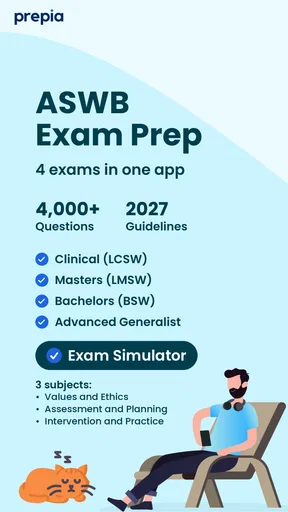
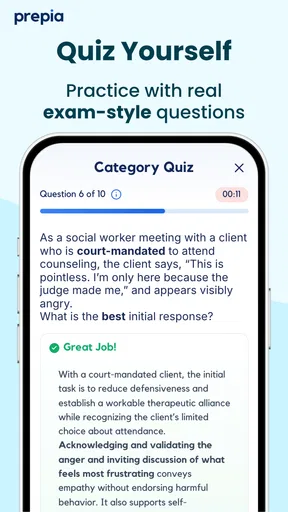
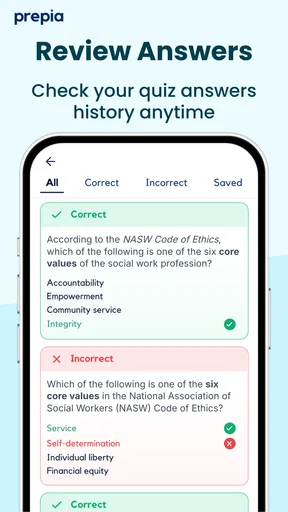
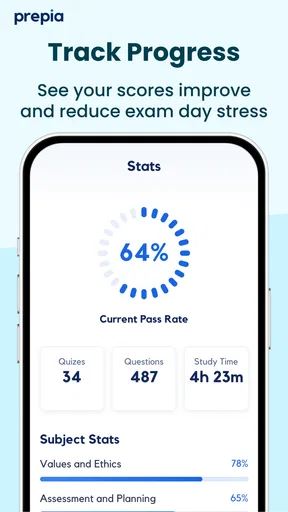
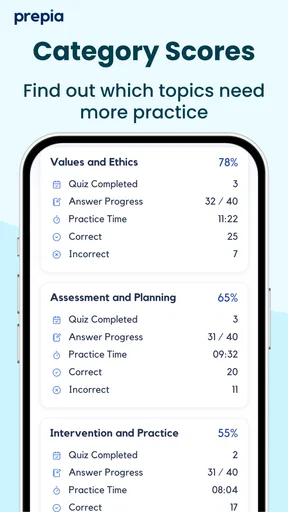
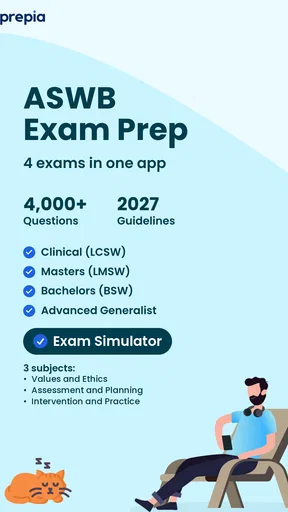
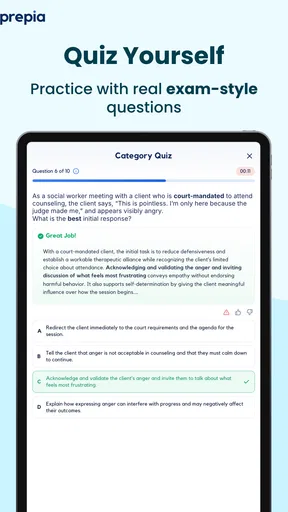
Our Review of ASWB BSW LCSW MSW | Exam Prep
 Analysis by Appyee
Preparing for a social work licensing exam is rarely a matter of simply reading a handbook from cover to cover. I found that the harder part is turning a large body of professional knowledge into quick, reliable decisions under exam pressure. ASWB BSW LCSW MSW | Exam Prep is built for that particular problem: it is an education app aimed at people preparing for BSW, LCSW, and MSW-level ASWB exams. My overall impression is that it works best as a focused practice companion, not as a complete replacement for structured study, supervision, or official exam guidance.
The app comes from Prepia Inc and is free to install, which makes it easy to test without committing money at the beginning. It is rated for Everyone, and its current version is 2.1.020. The app has reached over ten thousand installs and holds a 4.7 average from 275 ratings, so it has attracted a noticeable audience while remaining more specialized than a general study platform. Its in-app purchases range from $5.99 to $64.99 per item, an important detail to keep in mind before treating the free download as a complete preparation package.
From an uncertain starting point to a workable study routine
I would start using this app at the point where my study plan feels vague. That usually means I know I need to prepare for an ASWB exam, but I am unsure whether I am weak in ethics, assessment, intervention, or the judgment questions that ask for the best next action. A general flashcard app can help with terminology, but it often leaves the most important transition untouched: moving from remembering a concept to choosing an appropriate professional response.
The title makes the intended audience clear. BSW, LCSW, and MSW candidates are not necessarily studying at the same level or for the same professional goal, so the first useful decision is identifying which exam path matches my situation. I would not treat every question as equally relevant simply because it appears in an app carrying several exam labels. My workflow would begin by selecting the closest preparation track, then keeping a separate note of topics that feel unfamiliar rather than assuming one mixed score represents my readiness.
That distinction matters because social work exam questions often test prioritization rather than isolated facts. A learner may recognize a theory, a legal term, or a practice principle and still choose the wrong answer because the question is really asking what comes first. I found the app most useful when I approached each item as a decision exercise: identify the client’s immediate concern, notice the professional role involved, remove answers that jump too far ahead, and only then compare the remaining choices.
The strongest habit this app can encourage is explaining why an answer is best, not merely remembering which option was marked correct. I would keep a small error log beside the phone with three columns: the topic, the tempting wrong answer, and the clue that should have changed my decision. This turns short practice sessions into a growing map of mistakes. It is a more productive use of the app than repeatedly answering familiar questions until the screen feels comfortable.
A practical session flow that avoids passive studying
My routine would begin with a short session rather than an ambitious promise to study for hours. I would answer a group of questions without looking at outside material, mark every uncertain response mentally, and then review the reasoning behind both incorrect and guessed answers. The guessed answers matter because a lucky selection can hide a weak understanding just as easily as a wrong answer can reveal one.
After that first pass, I would sort the results into three working groups. The first would contain concepts I genuinely understand. The second would contain questions where I knew the subject but mishandled the order of action. The third would contain material I could not recognize at all. This simple separation helps prevent a common preparation mistake: spending all available time rereading comfortable topics while avoiding the areas that actually lower performance.
For a busy student, the app fits naturally into the gaps between larger study blocks. I could use it during a commute, before a placement shift, or while waiting for an appointment, then reserve a notebook or textbook for deeper review. The phone is good at prompting decisions and exposing weak spots; it is less suitable for replacing a full explanation of a complicated practice framework. That division of labor keeps the workflow realistic.
One useful technique is to answer a question, pause before checking the result, and say the reasoning aloud in plain language. For example, I might explain why safety assessment should precede a longer-term intervention, or why a boundary concern requires a professional response rather than an informal personal solution. Speaking the logic forces me to connect the scenario to an action sequence. It also makes the later review more precise than simply writing “wrong” beside a question number.
I would also avoid measuring progress by the number of questions completed. A high volume of quick attempts can create false confidence if I am repeating the same pattern without understanding it. A better outcome is being able to recognize the structure of a new scenario. If the app presents a familiar topic in unfamiliar wording and I can still identify the priority, it has contributed something meaningful to my preparation.
Where the handoffs happen between app, notes, and real study
The app is one part of a chain, and the handoffs between parts determine whether it helps. The first handoff is from a practice question to a personal explanation. I would not leave the result inside the app alone. I would write a short note describing the decision rule I missed, using my own words rather than copying a definition. This makes later revision faster because I am reviewing a problem I actually had.
The second handoff is from the note to a trusted learning source. If a question exposes confusion about ethics, diagnosis, crisis work, or professional boundaries, I would check a textbook, class material, supervisor, or other authoritative preparation resource. The app can point to a weakness, but a practice item should not become my only authority for a nuanced professional issue. This is especially important when a question feels ambiguous or when several options appear defensible without context.
The third handoff is from isolated practice to timed decision-making. I would occasionally combine topics instead of studying one subject in a perfectly predictable order. Real exam conditions do not announce that the next question will involve the same concept as the previous one. Mixing areas makes it harder to rely on memorized patterns and gives a more honest sense of whether I can switch mental gears.
There is also a handoff between different candidates. A BSW student, an MSW graduate, and an LCSW candidate may use the same app for different reasons, but they should not assume that one person’s study routine transfers directly to another. I would use the app to support the exam level I am actually pursuing and discuss unclear items with someone familiar with that level. The shared label is useful for discovery, but it does not erase the differences in experience and preparation needs.
In everyday use, this might look like a twenty-minute session after work. I answer questions on my phone, notice that I repeatedly choose an intervention before clarifying immediate risk, and add that pattern to my notes. Later that evening, I review the relevant section in my main study material and write a short rule for future scenarios. The next day, I return to practice without rereading everything. That loop—attempt, diagnose, verify, retry—is where the app earns its place.
What the workflow produces when it is used well
The result I would expect from consistent use is not instant mastery. It is a clearer picture of how I make decisions. The app can help reveal whether I am losing points because I forget content, misread the client’s priority, overlook an ethical boundary, or rush toward an answer that sounds helpful but is not the best first step. Those are different problems and require different fixes.
For me, the most valuable outcome would be greater speed with less guessing. A good practice session should eventually make the opening scan of a question more disciplined: who is at risk, what role is being tested, what action is immediate, and which answers are too extreme or premature? That kind of pattern recognition is more transferable than memorizing a sequence of correct letters.
The app’s free entry point is another practical advantage. I can install it and see whether its question style suits me before deciding whether an optional purchase is worthwhile. I would approach the paid items carefully, however. The listed range reaches from $5.99 to $64.99 per item, so I would first identify the exact gap I am trying to solve and avoid buying material simply because I feel anxious about the exam. Anxiety can make every extra resource look necessary.
Its audience size also gives me some confidence that the app is not an abandoned experiment. The rating of 4.7 from 275 ratings is encouraging, but I would still judge it by my own experience with the explanations, difficulty, and relevance to my exam path. Ratings are a useful signal for trying an app; they are not proof that every candidate will find the same questions or workflow effective.
The age rating of Everyone makes the app broadly accessible, but that should not be confused with professional completeness. The subject matter is specialized even though the app is not restricted to adults. A learner still needs to bring maturity, ethical care, and awareness of the limits of practice questions. The format may be simple to open, but the decisions being studied can involve serious client situations.
Where this approach is better than usual alternatives
Compared with paper flashcards, the app has a more direct connection to scenario-based decision practice. Flashcards are excellent for definitions, stages, terminology, and quick recall, but they can encourage a one-word answer style. A question-focused mobile tool is more useful when I need to practice choosing among plausible actions. I would still keep flashcards for facts that genuinely require memorization, rather than forcing the app to do a job it was not designed to replace.
Compared with a long textbook, the app is easier to use in short bursts. A book gives more room for context, exceptions, and detailed explanations, while a phone makes it easier to return to a weak topic several times during the week. My preference would be to use the app as the active layer and the textbook as the reference layer. Reading first and never testing myself can feel productive without showing whether I can apply the material.
Compared with a live course or study group, the app offers privacy and flexibility. I can work through a question at my own pace and revisit a mistake without feeling embarrassed. The trade-off is that it cannot automatically provide the discussion, accountability, or personalized correction that another person can offer. If I repeatedly misunderstand why one option is preferable, a tutor, instructor, or study partner may be a better next step than more solitary practice.
Compared with a generic quiz application, its specific focus is the reason to choose it. I am not opening it for broad academic trivia or general productivity. I am opening it because my target is an ASWB-related exam and I want practice that stays close to social work decision-making. That focus saves time, although it also means the app has less value once my exam preparation moves into unrelated professional development.
Friction points that can interrupt the study chain
The first limitation is the risk of mistaking question familiarity for readiness. Repeating a set until the answers feel obvious can train recognition of the screen rather than understanding of the scenario. I would deliberately space out reviews, change the order of topics, and explain answers without looking at previous notes. If I cannot do that, my apparent improvement may be narrower than it seems.
The second limitation is the need for external judgment. Exam preparation questions are useful prompts, but social work practice depends on context, ethics, law, agency policy, and professional responsibility. I would never use a practice answer as a substitute for guidance in a real client situation. The app belongs in study time, not in place of consultation when an actual person’s safety or rights are involved.
The third limitation is cost uncertainty at the point where preparation becomes serious. The app is free to install, but optional purchases can become significant depending on what I choose. I would set a budget before purchasing, compare the material with resources I already own, and avoid assuming that the most expensive option is automatically the best fit. A free trial period of my own—using the available content consistently before buying—would make the decision more rational.
Another possible source of friction is choosing the wrong preparation level. Someone preparing for an advanced clinical exam may need to think differently from someone beginning at the BSW level. If I answer mixed material without tracking the target exam, my error log becomes noisy and my study time less efficient. The solution is simple but important: label notes by exam path and review the questions that match the credential I am pursuing.
I would also skip this app as my main resource if I learn best through extended explanations, group discussion, or instructor feedback. A question-and-answer routine can feel too narrow for someone who needs a guided curriculum from the beginning. In that case, a structured course or comprehensive book should lead the plan, with this app serving as an occasional practice tool rather than the center of the workflow.
My recommendation for candidates deciding whether to install it
I see ASWB BSW LCSW MSW | Exam Prep as a sensible addition for candidates who already have some study material and want a convenient way to test decisions repeatedly. It is especially appealing if I tend to read passively, postpone practice questions, or struggle to identify the difference between a reasonable answer and the best first response. The free installation lowers the risk of trying it, while the specialized focus keeps sessions more relevant than a generic quiz app.
I would use it with a clear routine: choose the correct exam track, complete a short set, record uncertain answers, verify difficult concepts elsewhere, and return later without relying on memorized choices. I would review progress by the quality of my reasoning, not only by a score. I would also keep paid purchases deliberate, because the available items span a wide price range and more content is not automatically the same as better preparation.
Prepia Inc has made a focused education app that fits naturally into the small spaces of a demanding schedule. Its 2.1.020 release is the version I would evaluate when installing it, and its broad Everyone rating makes the app approachable for a wide audience. Still, approachability should not lead me to oversimplify the work. Passing an ASWB exam requires disciplined study, careful interpretation, and a reliable understanding of professional responsibilities.
My final view is positive but measured. I would recommend it to a social work candidate who wants frequent scenario practice and is willing to connect each result to deeper learning. I would not recommend relying on it alone, especially for someone who needs comprehensive teaching or personalized feedback. Used as the active practice step between reading, discussion, and review, ASWB BSW LCSW MSW | Exam Prep can turn uncertain study time into a more organized path from question to reasoning to improved exam readiness.
Verdict
Strengths of ASWB BSW LCSW MSW | Exam Prep
- Covers multiple ASWB exam levels in one app
- Practice questions help identify weak subject areas
- Useful for short study sessions during commutes
- Progress tracking makes revision easier to organize
- Mobile access reduces reliance on printed study guides
Limitations of ASWB BSW LCSW MSW | Exam Prep
- Some explanations may feel too brief for difficult concepts
- Question difficulty may not perfectly match the real exam
- Full access may require an in-app purchase or subscription
- Content updates may lag behind changes to exam guidelines
- Studying on a phone can be distracting during longer sessions
Other Releases by Prepia Inc
View All
AMERICAN NURSE EXAM PREP 2026
Education4.8

Prepia PTCB PTCE Exam Prep
Education4.7

ATI TEAS Exam Prep 2026
Education4.7

NREMT EMT EXAM PREP 2026
Education4.6
Similar Picks in This Category
View All
Duolingo: Language Lessons
Duolingo4.7

Google Classroom
Google LLC2.8

Unacademy: Learn & Crack Exams
Unacademy3.2

Bible App for Kids
Life.Church4.4

Cake - Learn English & Korean
Cake Corp.4.7

Brainly: AI Homework Helper
Brainly4.5
Frequently Asked Questions
What is ASWB BSW LCSW MSW | Exam Prep?
ASWB BSW LCSW MSW | Exam Prep is a study application designed for candidates preparing for Association of Social Work Boards examinations. It typically provides practice questions, explanations, quizzes, and progress-tracking tools for social work levels such as Bachelor, Master, Clinical, and Advanced Generalist. The app is intended to support revision and exam familiarity, but it should be used alongside official ASWB materials and a structured study plan.
Which ASWB exam levels does the app support?
The application is aimed at several ASWB examination categories, including BSW, MSW, and LCSW preparation, although the exact labels and available question banks may vary by version. Before downloading or purchasing premium content, candidates should check that their chosen exam level is specifically included. Selecting the correct level is important because the scope, terminology, and difficulty of questions can differ considerably between social work licensing examinations.
Does the app contain real ASWB exam questions?
Users should not assume that the questions are copied from the official ASWB examination. Exam-preparation apps generally provide independently written practice questions designed to resemble the format, themes, and reasoning required on test day. They can be useful for identifying weak areas and practicing timed responses, but they cannot guarantee that the same questions will appear in the real exam. Always confirm licensing information and rely on official ASWB guidance for current exam policies.
Is ASWB BSW LCSW MSW | Exam Prep free to use?
The app may offer free access to a selection of practice questions or basic study features, while additional question sets, explanations, statistics, or unlimited practice may require an in-app purchase or subscription. Pricing and included features can change depending on the platform and app version. Review the store listing carefully before downloading, and check subscription terms, renewal conditions, refund policies, and whether content remains available after canceling.
Can this app replace an ASWB study course or official study materials?
No. ASWB BSW LCSW MSW | Exam Prep is best viewed as a supplementary revision tool rather than a complete replacement for official resources, textbooks, supervision, or a formal preparation course. Practice questions can improve familiarity with exam-style decision-making, but successful preparation also requires understanding ethics, assessment, intervention, human development, and jurisdiction-specific requirements. Candidates should verify all important information against current ASWB and licensing-board documentation.
